Between the Lines
Reflections through Susan Abulhawa’s "Mornings in Jenin"

Some books end when you turn the last page. This one did not.
I finished reading Mornings in Jenin carrying a quiet sadness and a void I couldn’t quite name.
To immerse myself in the story of people who love so deeply, whose hearts seem larger than the world around them, and whose survival runs through their veins. Across four generations, I walked with characters shaped by loss, grief, separation, and longing, but also by love, memory, and an unwavering attachment to home.
This novel does not simply explain Palestine, its history, and its enduring spirit, or recount atrocities. It carries something more layered than that. It holds community and belonging, love in its purest form, and pain all existing side by side, bearing witness to lives unfolding within it.
It made me realize that sometimes to understand history is not to analyze it, but to live with it for a while, to witness it through story. Literature, in that sense, becomes a form of resistance. It preserves what might otherwise be erased.
Beyond the headlines, you begin to feel the human weight of it all:
a mother longing for her son, stolen by an occupier,
a daughter yearning for ordinary mornings with her father that can never return,
a man who loves his wife so deeply, yet loses her in the most brutal way with their unborn child
“Not even in death has our love faded, for I live in your veins.” Mornings in Jenin, Susan Abulhawa
Lives stitched together through letters, distance, memory, and across borders and absence.
What moved me most was not the violence itself, but the tenderness of the people. Their refusal to let such circumstances strip them of softness. Their generosity. Their care for one another. Their insistence on blessing instead of merely thanking, phrases that turn gratitude into prayer. The way culture, language, food, memory, even the rhythm of dabke becomes a way of saying: we are still here.
Running through the novel is also a question that lingers without answer:
Is this what it means to be Palestinian?
The question lingers, unanswered, as the story moves on.
There are parts of this story that resist being put neatly into words. Some experiences cannot be summarized; they can only be deeply felt, sympathized with, and remembered.
Reading a book like this feels like an act of remembering beyond the news headlines.
A quiet resistance.
A choice to witness, to learn, to glimpse what it means to live through such realities
Perhaps that is the enduring power of literature. Through it, I found myself moving through different cities in Palestine, from Ein Hod to Jenin to Jerusalem, across places I have never seen, yet somehow felt close to. Stories I may never return to, yet now woven into me.
I didn’t just finish this book.
It has stayed with me.
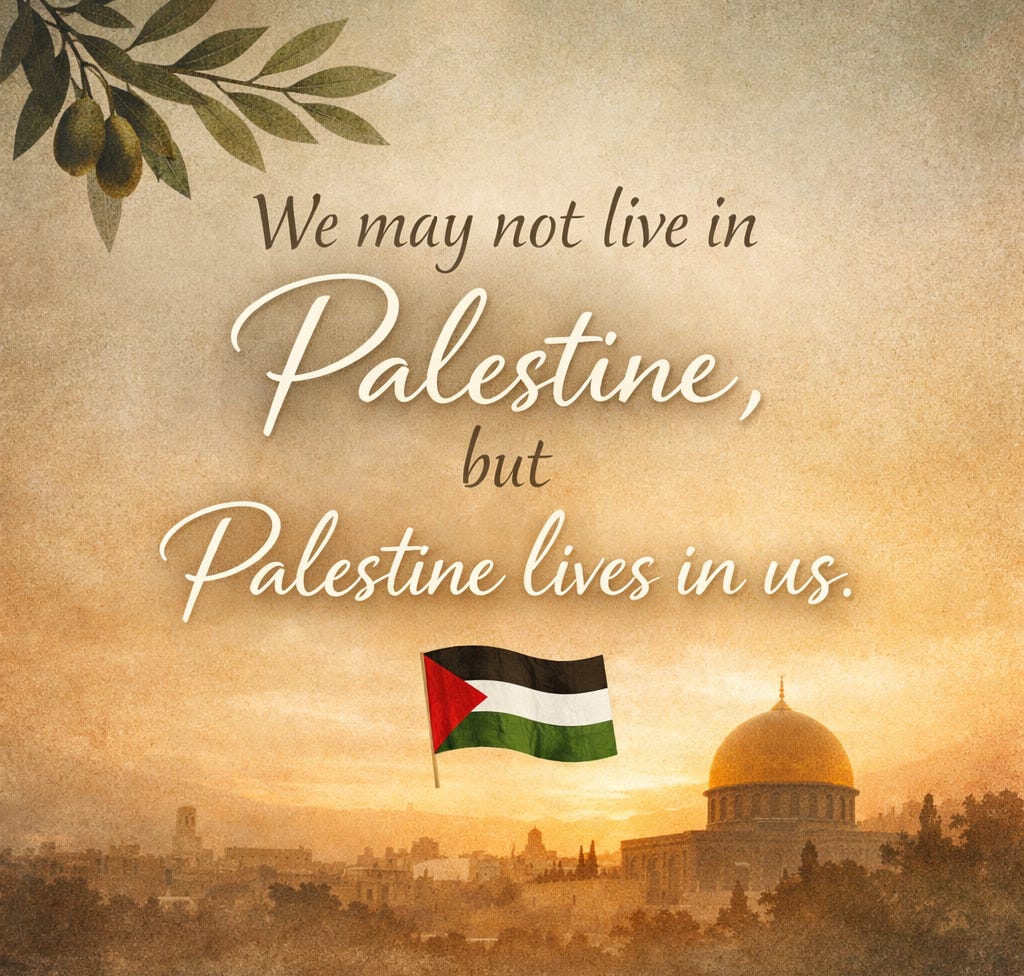
To you, Palestine, heart of the Ummah.
May Allah preserve you and your people, and envelop you in His mercy.
May your hearts be filled with His nearness when the world feels distant to your suffering.
Free Palestine 🇵🇸